India, Uzbekistan to boost antiterrorismCooperation, defence, trade
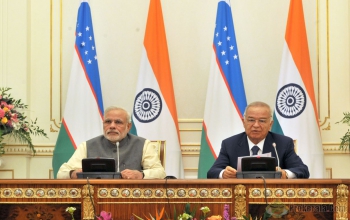
India and Uzbekistan on July 6 agreed to boost cooperation in fighting terrorism and in the field of defence and cyber security as Prime Minister Narendra Modi held talks with Uzbekistan President Islam Karimov, on his first stop on his Central Asian tour. Modi and Karimov also discussed ways to boost connectivity and trade on uranium supplies to India. The joint statement issued after the talks said "President Karimov noted that strengthening relations with India is one of the top foreign policy priorities of Uzbekistan, while Modi emphasised that a strong strategic partnership between India and Uzbekistan is a key pillar of India's engagement with Central Asia". In his media statement following the talks, Modi said both sides discussed steps to implement the contract signed earlier for supply of uranium from Uzbekistan. Modi said he briefed Karimov about the International North South Transport Corridor and proposed that Uzbekistan become a member. "I sought his support for India joining the Ashgabat Agreement" -- a transport corridor that would link Central Asia to the seaports in the Persian Gulf and Gulf of Oman. He also said both countries will also seek to work in the framework of the Shanghai Cooperation Organisation (SCO). Modi said his five-nation tour of Central Asia reflects India's resolve to start a new era in ties with the Central Asian republics. He said his visit to Uzbekistan underlines its importance for India, "not just in the context of this region, but also more broadly in Asia". "I share President Karimov's desire to raise the level of our economic engagement. I conveyed to him that there is a strong interest in Indian business to invest in Uzbekistan. I have urged him to make the process and the policies for Indian investments here smoother. President responded positively to my suggestion," he said. He said the Uzbek president was supportive of strengthening ongoing cooperation in the areas of agriculture, information technology and energy. "We also discussed regional and international issues, including the situation in Afghanistan. We also have shared concerns on the rising threat of extremism and terrorism in our extended neighbourhood," he said. He said he would be visiting the memorial of late Indian Prime Minister Lal Bahadur Shastri on Tuesday and thanked Uzbekistan for "preserving the legacy of our former prime minister". He said his visit and talks were "very rewarding" and would lay the foundation for a "rich harvest in years ahead". Earlier, the two sides inked agreements for furthering cooperation between their foreign offices and in the fields of culture and tourism. On security cooperation, the joint statement said both sides expressed their intention to strengthen coordination between the law enforcement agencies and special services of the two countries, including under the framework of the Uzbekistan-India Joint Working Group on Counter-Terrorism. They also agreed to expand cooperation in the fields of defence and cyber-security. The joint statement calls for UN reforms. Uzbekistan also reaffirmed its support to India's candidature for permanent membership of the UNSC. Both sides also welcomed the proposal to set up telemedicine links connecting medical institutions in Uzbekistan and India for consultations. In the joint statement, both sides agreed to expand cooperation in transport and communications - particularly civil aviation and surface connectivity. In the joint statement, President Karimov noted that strengthening relations with India is one of the top foreign policy priorities of Uzbekistan. Modi, who arrived earlier in the day, was accorded a ceremonial welcome at the Kuksaroy presidential complex. He later attended a banquet dinner hosted by President Karimov. In his banquet address, Modi spoke of the age old cultural links between the two countries. "We have enriched each other in the past but now we are building a relationship that will give out people a prosperous future," he said.
Modi Visit: India, Kyrgyzstan boost Defence cooperation
India and Kyrgyzstan on July 12 inked four agreements, including in defence cooperation and between their election commissions, as Prime Minister Narendra Modi held talks with President Almazbek Atambayev. Visiting Bishkek, the penultimate stop of his tour of Central Asian countries, Modi in his media statement said his visit to all five countries in the region "demonstrates the importance that we attach to a new level of relationship with Central Asia. Kyrgyzstan is a key part of that vision". Modi said resource-rich Central Asia has an important place in India's future and both sides seek a peaceful and secure neighbourhood and have a shared interest in combating extremism and terrorism. The agreement on defence cooperation was in matters relating to defence, security, military education and training, conduct of joint military exercises, exchange of experience and information, exchange of military instructors and observers. Modi said their defence ties were strong and the agreement would help broaden their defence cooperation. The Special Forces of the armed forces of the two countries held joint exercise "Khanjar 2015" in Kyrgyzstan in March, "which reflected continuity in exercises held in India in 2011. It was decided to hold joint exercises on an annual basis", said the joint statement. The Kyrgyz side expressed its appreciation to India for "training Kyrgyz military officers for conducting various UN Peacekeeping Courses, including by the Centre for UN Peacekeeping in New Delhi", the statement said. Modi said the IT Centre in the Kyrgyz Military Academy "is an example of innovative cooperation that is important to both countries" and the new agreement would provide a framework to broaden engagement. Modi expressed happiness at the cooperation agreement between the election commissions and said he looked forward to the visit of a Kyrgyz parliamentary delegation to India. The other two agreements were a MoU between Kyrgyzstan's economy ministry and the Bureau of Indian Standards on cooperation in the field of standards, and an agreement on cooperation in culture. Modi said both sides discussed at length about boosting trade, investment, tourism, culture and human resource development and added that the connectivity initiative between India and Central Asia will further boost economic ties. Modi also thanked Kyrgyzstan for its support to India's candidature for a permanent United Nations Security Council seat. In the joint statement, India reaffirmed support of the candidacy of the Kyrgyz Republic for the UN Human Rights Council for 2016-2018. Both sides expressed "grave concern at the rising trend of extremism, radicalism and terrorism in the region and whole world" and India "highly appreciated the steps taken by the Kyrgyz government in counteracting terrorism and in retaining the secular character of Kyrgyz society". The two sides agreed to expeditiously consider signing an agreement on "combating international terrorism and other crimes", the statement said. They also agreed to boost economic, trade and investment linkages which were below potential. Modi also congratulated Atambaev on Kyrgyzstan's joining the Russia-led Eurasia Economic Union and both Sides agreed to work together for early conclusion of a Free Trade Agreement between the Eurasia Economic Union and India said the joint statement. Modi said both sides would hold a roundtable in Bishkek in the field of agriculture to explore possible avenues for cooperation and identify concrete projects. India has offered to share its experience in agro-processing, greenhouse technology, water conservation, and agricultural research with Kyrgyzstan. The joint statement also expressed satisfaction over "growing links in the health sector, including regular visits by doctors from super-specialty hospitals in India to Kyrgyzstan, visits of patients from Kyrgyzstan to India for medical treatment and complex surgery at affordable cost and international standards, and the gifting of a computed tomography machine to the National Center for Cardiology and Internal Medicine (NCCIM) by the government of India in September 2014". It also welcomed the launch of a project to establish tele-medicine links between highly specialised hospitals of India and six medical establishments of Kyrgyzstan. At the lunch banquet, Atambayev said "India has a calling to become a great economic power like the US and China". Modi later met Kyrgyz parliament Speaker Asylbek Jeenbekov and also held talks with Prime Minister Temir Sariyev. During his meeting with Sariyev, Modi gifted medical equipment to Kyrgyzstan's Level II Field Hospital. He also visited the Kyrgyz-India Mountain Biomedical Research Centre. Modi gifted the president a hand-knotted carpet of very fine grade wool blended with silk.
India, Turkmenistan push for early completion of TAPI pipeline
India and Turkmenistan on July 11 agreed to push for early implementation of the ambitious TAPI gas pipeline project as Prime Minister Narendra Modi held talks with Turkmen President Gurbanguly Berdimuhamedov. The two sides inked seven agreements, including for cooperation in fertilisers and in defence. Modi, who arrived in the Turkmen capital on July 10 evening from Ufa in Russia, said in his media statement after Saturday's talks that the Turkmenistan-Afghanistan-Pakistan-India (TAPI) pipeline project was the "most significant initiative in our relationship". "This could transform regional economic cooperation and bring prosperity along the route. We welcomed the agreements between the four countries for the pipeline. We underlined the need to implement the project quickly," he said. Modi said he proposed that both sides should explore multiple options, including the land-sea route through Iran, for transporting the gas. The $10 billion TAPI project is expected to bring Turkmen natural gas from its giant Dauletabad and Galkynysh gas fields to Pakistan and India. The project is likely to take off in December. The joint statement said the TAPI project "forms a key pillar of economic engagement between the two countries" and its implementation will have "a transformational impact on trade between the two countries". Both sides decided to "take measures for early implementation of this important regional project". Modi also said he conveyed India's interest in long-term investment in the energy sector in Turkmenistan. ONGC Videsh Limited is to open an office in Ashgabat. Stressing on connectivity, Modi expressed gratitude for Turkmenistan's support to India in joining the Ashgabat Agreement on trade and transit. The Ashgabat Agreement is a transit agreement established in year 2011 between the countries of Uzbekistan, Iran, Turkmenistan and Oman. Kazakhstan has also joined the bloc. Modi said he proposed that Turkmenistan join the International North South Transport Corridor project, which aims to connect Mumbai to St. Petersburg. "Together with the Kazakhstan-Turkmenistan-Iran rail link, and India's proposed investment in Chahbahar Port in Iran, these initiatives will strengthen connectivity between our countries," he said. The two leaders welcomed the signing of a MoU between the state-led Turkmenhimiya and Indian PSU Rashtriya Chemicals and Fertilizers Limited to provide a framework for long-term sourcing of urea from Turkmenistan. The leaders welcomed the Indian proposal to set up a urea production facility in Turkmenistan in collaboration with Turkmen entities, said the joint statement. In the field of terrorism, both sides agreed to step up efforts against cross-border threats such as terrorism, organised crime and illegal drug-trafficking. Both also welcomed the signing of the Defence Cooperation Agreement, which would provide a framework for intensifying bilateral defence and security cooperation through exchanges of high and mid-level visits, training and dialogue between the defence ministries. Modi said the defence agreement "is a reflection of our shared interest in closer security cooperation, including in combating terrorism". "As India deepens its relations with Central Asia, Turkmenistan will play an essential part," Modi said. Later, Modi inaugurated a traditional medicine and yoga centre in the Turkmenistan capital and unveiled a bust of Mahatma Gandhi at the centre. He praised the local students for a demonstration of yoga they presented. "I give you 100 on 100 marks for the yoga demonstration. Yoga teaches people to be one with nature. Its aim is not just physical exercise, it also touches the mind and soul," he said. Modi hoped the yoga centre and the Mahatma Gandhi bust would spread a positive message across Central Asia. Modi also laid a wreath at the mausoleum of Turkmenistan's first president Saparmurat Niyazov. He also presented a specially handcrafted horse saddle to Berdimuhamedov, known to be passionate about horses. Turkmenistan was the fourth stop on Modi's tour of Central Asian countries. He has visited Uzbekistan and Kazakhstan. He was in Ufa in Russia for the BRICS and SCO summits. He travels to Kyrgyzstan and Tajikistan later.
Xiaomi to develop e-commerce business model
Xiaomi, the world's third-largest smartphone maker, is developing a full-fledged e-commerce business model for its phones and other devices which it plans to introduce soon in the Indian market. Xiaomi India head Manu Kumar Jain told reporters here on July 10 that they are looking to invest in few startup technology companies to develop an eco-system. He said investment would be made in setting up e-commerce business including warehouse and logistics. He, however, did not disclose the quantum of investment. Currently the major portion of the Chinese smartphone maker's sales come through its portal (me.com) and channel partners Flipkart, Amazon and Snapdeal. Xiaomi will also be investing in expanding research and development centre in Bangalore, setting up a manufacturing facility and expanding exclusive sales and service network. The R&D centre in Bangalore currently employs only four professionals but it will have a 100-member team by the end of this year. The team will design new mobile technology features for Indian consumers. Jain said the company was in talks with various state governments for setting up its manufacturing facility. It plans to make the phones through a contractual manufacturer. Xiaomi has sold over a million smartphones in the first four months of its entry into the Indian market in July 2014, making it the fifth-largest player in the domestic market with a share of four percent. The five-year-old company, which rolled out its first smartphone in August 2011, sold 61.1 million units globally last year, as against 18.7 million units in 2013. The company is also looking at introducing non-phone products like smart Internet-connected devices in the Indian market. It plans to launch Xiaomi Mi Box, a tiny box that turns an ordinary TV into a smart TV, by the end of current calendar year. Xiaomi smart TV will be available next year. Jain said Xiaomi was also aggressively looking at parking investments in Indian startups, especially in the areas of Internet technology and connected devices. One of the top angel investors in China, it has already invested in over 20 startups in the home country. Xiaomi's founder Lei Jun had in February this year secured $160 million for his China-focused venture capital fund Shunwei China Internet Fund to invest in more Chinese startups. Founded in 2011, the Shunwei China Internet Fund currently has over $900-million assets under management.
Singapore building agency keen to join India's smart city project
The state-run Building and Construction Authority (BCA) of Singapore on uly 10 said it wants to associate with the Indian government's Smart City project. "We want to collaborate with the smart city project and make sustainable environment in India by 2025," BCA group director Koh Lin Ji told reporters here on Thursday. The seventh edition of the green building week conference will be held next month in Singapore. "Over 30,000 participants from over 55 countries are expected at the seventh edition of the green building week which will run from August 31 to September 6 in Singapore," said Prem C. Jain, chairman of the Indian Green Building Council (IGBC).Vivian Balakrishnan, Singapore's Minister for Environment and the Smart Nation Initiative, will deliver the opening address. BCA is a platform for stakeholders from both public and private sectors in Singapore and Asia Pacific, Lin Ji said. In February, Singapore President Tony Tan Keng Yam made his maiden visit to India also as part of celebrations to mark the 50th anniversary of diplomatic relations between the two countries. President Tan met Prime Minister Narendra Modi and External Affairs Minister Sushma Swaraj, while their talks covered new focus areas which are part of India's development process like the Smart Cities and urban rejuvenation initiatives, promoting skill development and measures to speed up connectivity and coastal and port development.
Alibaba.com extends global resellers platform to India
Strengthening its direct presence in the Indian e-commerce market, Alibaba, the world’s largest e-commerce company, on July 10 launched a reseller platform in the country. Targeted at exporters and small-scale manufacturers, the platform seeks to gain from global interest in Indian apparel, jewellery, handicraft and food & agro products. So far, the company’s presence in India was largely in the direct selling segment, where buyers and manufacturers buy and sell products directly, through various Alibaba portals. This comes ahead of Alibaba announcing a major play in India’s online business-to-consumer segment. Recently, Alibaba’s financial arm, Ant Financial, had acquired 25 per cent in Paytm’s parent company, One97 Communications. Sources say the Chinese e-commerce major is likely to invest about $600 million directly into Paytm soon. Alibaba founder Jack Ma is expected to be in India for the announcement. Alibaba has huge presence in the global business-to-business segment. It claims to serve buyers and sellers across 190 countries. Friday’s development is an extension of the Alibaba.com global business-to-business e-commerce platform, which seeks to connect manufacturers and wholesale exporters with buyers, bypassing traditional trading channels. The company claims e-commerce cuts costs and delays pertaining to offline trading channels and, therefore, expands the market for small-time exporters and importers. “Though it’s difficult to quantify, we played a key role in opening the Chinese SME (small and medium enterprise) sector to global trade,” says Timothy Leung, head of global business development, Alibaba. Through this initiative, the Chinese e-commerce giant will work directly with Indian exporters and manufacturers, akin to its operations in its home market. “We are launching our trade facilitation centre in India to provide support to small and medium businesses with a full suite of export-import services, including logistics, financing and credit support,” Leung said. Unlike customer-oriented e-commerce companies, which earn through commission on individual sales, Alibaba will earn through listing fee or membership fee from resellers and manufacturers. “India has one of the largest manufacturing systems in the world, with about 22 million manufacturers of all kinds. Our idea is to open the global trade opportunity to all of them, irrespective of their size,” Leung said. There was huge customer appetite for ethnic products from India, especially apparel, handicraft, jewellery and food products, he said, adding most small and local manufacturers were missing out on the opportunity either due to lack of awareness or high cost. “The popular way for SMEs to export is to participate in global trade shows such as the Frankfurt Show and work on the leads generated there. But this costs thousands of dollars and might not suit every exporter and manufacturer. For the same money, an SME can list on the B2B platform for five years and access buyers across 190 markets without any incremental cost.” During the year ended March this year, gems & jewellery, apparel and garments and cereals together accounted for 23.4 per cent of India's overall merchandise exports, valued at 310 billion, according to data from the commerce ministry. Handicraft exports were estimated at $4.5 billion, against $3.8 billion in FY14. Alibaba is adopting an incremental approach to cover various manufacturing clusters in India. “In India, the SME sector is concentrated in clusters, with each offering some unique products. So, we are approaching one cluster at a time and appointing partners in each to tap local opportunities,” Leung said. Alibaba’s new initiative has come at a time when exports from India have been declining, owing to a mix of poor global demand and appreciation in the rupee against competing currencies. In April this year, exports fell 14 per cent to $22 billion, the fifth consecutive monthly decline.
India-Russia-Iran transport corridor will boost trade with Central Asia'
The proposed International North South Transport Corridor expected to be discussed during Prime Minister Narendra Modi's ongoing five-nation tour to Central Asia will to give a major boost to India's trade with the region, industry chamber FICCI said on July 6. "The International North South Transport Corridor (INSTC), which may figure in the talks between the leaderships of the Central Asian countries and Indian officials, once fully operational, will address the issue of poor connectivity and high transport costs to a large extent," the Federation of Indian Chambers of Commerce and Industry said in a statement here. A high-powered FICCI delegation, representing sectors such as construction, pharmaceuticals, mining, banking, power transmission and IT, is accompanying the prime minister on his visit to Kazakhstan on July 7 and 8, it said. "Top Indian companies such as Essar Group, GMR, BHEL, NASSCOM, Punjab National Bank, Lupin, Punj Llyod and SUN Group are being represented in the business delegation," it added. The INSTC agreement was signed more than a decade ago with Russia and Iran for better connectivity to the Eurasian region through Iran. The INSTC members met last month and reviewed the status of report on the dry run between India, Iran and Russia via the Caspian Sea, while a follow-up meeting has been slated for this month. The transport corridor across Nhava Sheva (Mumbai) through Bandar Abbas port (Iran) to Astrakhan (Russia) and Baku (Azerbaijan) is expected to substantially cut cargo transportation time between India, the Central Asian region and Russia. Modi is also slated to visit Ufa City in Russia for the Shanghai Cooperation Organisation (SCO) and BRICS summits, where he will also have an extended meeting with Russian President Vladimir Putin on plans to further the strategic partnership between their countries. Modi's visit to the Central Asian countries will be the first by an Indian prime minister after Jawaharlal Nehru to a region linked by history with India. While Kazakhstan is a major oil producer and Turkmenistan and Uzbekistan have some of the biggest natural gas reserves, Tajikistan and Kyrgyzstan are estimated to have considerable untapped reserves.
India to help build infrastructure in Central Asia: Modi
Prime Minister Narendra Modi on July 10 said India will help develop infrastructure in the Central Asian region. "Our ties with Central Asia are very old," Modi said while addressing the 15th Shanghai Cooperation Organisation (SCO) summit here. "India will be pleased to contribute to the development of infrastructure in the region," he said. The prime minister noted that India has been "actively participating in SCO activities that are open to observers". "Our membership of SCO is a natural extension of these relationships and mirrors the region’s place in India’s future,” he said. SCO leaders are set to pass a resolution on starting the procedures to grant India and Pakistan full membership of the organisation. Founded in 2001, the SCO has China, Kazakhstan, Kyrgyzstan, Russia, Tajikistan and Uzbekistan as its full members. Afghanistan, India, Iran, Mongolia and Pakistan are observers while Belarus, Turkey and Sri Lanka are dialogue partners. Modi said India would “support efforts to create an environment that eases barriers and facilitates trade and investments in the region”. Observing that the SCO region is characterised by a rich diversity of cultures, Modi said: “Our association with SCO will seek to advance our shared vision to reconnect and integrate Eurasia’s different regions.” He also called for promoting deeper understanding and exchanges, saying that these, “especially among our youth, will promote greater unity in the region and beyond”. “The future of prosperity rests on the foundation of peace. India will contribute to advancing peace and friendship in the region,” the prime minister said. He said India would join SCO in the fight against terrorism. “We will work with SCO to combat terrorism and extremism.” Assuring India's full cooperation to the SCO, Modi said: “For the past few centuries, we have all looked away from the centre of this great landmass, towards the sea and other regions. The time has come reach out to each other across the region.” He said India looked forward to lending its support to “building infrastructure, easing barriers of trade, expanding connectivity”. The prime minister said India would deepen its engagement with SCO member-states in human resource development, information and communication technology, pharmaceuticals and health, banking and capital markets, micro- small and medium enterprises (MSME), micro-finance and food security. “SCO is an important part of our vision. I assure you of India's full cooperation to SCO,” Modi said in his speech. In the course of his speech, he also congratulated Pakistan for joining the SCO.
Rosneft signs deal to take a 49% stake in Essar Oil
Russian oil major Rosneft has signed a preliminary agreement with the Essar group, controlled by the Ruias, to buy a 49 per cent stake in Essar Oil’s Vadinar refinery and supply 100 million tonnes of oil to the latter for the next 10 years. Refining accounts for over 95 per cent of Essar Oil’s overall business. The deal is subject to regulatory approvals. According to the deal contours, Rosneft will supply five million tonnes of crude oil to Essar Oil in 2015. Rosneft and Essar Oil had last December signed a preliminary contract for supply of 10 million tonnes of oil a year for 10 years. Commenting on the signing of the agreement, Rosneft Chairman Igor Sechin said: “The performance of the terms of the signed documents will have a substantial impact on the scale of economic cooperation between Russia and India. The goods trade between the two countries will grow by more than 50 per cent.” Rosneft and Essar also plan to boost refinery output from 20 million tonnes a year to 45 million tonnes by 2020. The deal also includes a retail chain of 1,600 stations located in India; the parties plan to increase the total quantity of retail sites to 5,000 within the next two years. Before the announcement of the agreement, the Essar Oil stock was trading 3.74 per cent higher than its previous BSE close, at Rs 188.6 a share. At Wednesday’s closing price, Essar Oil’s market capitalisation stands at Rs 27,337 crore. Sources had earlier told Business Standard that the deal would fetch Essar Oil over Rs 10,500 crore, which might help the company reduce its debt burden. As of June this year, it had a debt of Rs 17,000 crore on its books. To complete its debt-dollarization programme, the company is in the process of availing of long-term export advance facility of $1.6 billion, backed by export performance bank guarantee/standby letter of credit, to repay the high-cost rupee loans. Last April, Essar Oil had received the Reserve Bank’s approval to raise external commercial borrowings to the extent of $2.27 billion, to replace its rupee debt with low-cost dollar loans. The company has already refinanced an equivalent amount of its rupee loan with a foreign-currency debt of $1 billion through use of ECBs and by swapping rupee loans with dollar ones. Essar Oil owns and operates a refinery in Gujarat’s Jamnagar. Among its other assets are a few exploration and production blocks and coal-bed methane blocks. The company reported a profit of Rs 1,521 crore on revenue of Rs 83,206 crore in 2014-15, mainly on account of higher gross refining margins of $10 a barrel.
Japan's sportswear brand ASICS opens first standalone store in India
What’s common to Bruce Lee, Barack Obama and the Australian cricket team? ASICS sports shoes, made by the Kobe, Japan based shoe and apparel maker. Martial artist Lee wore them in one of his movies in 1970. US President Obama was photographed wearing them recently. The latest to be spotted with ASICS was the Australian cricket team in the final match of the Cricket World Cup 2015. On July 8, ASICS Corp. opened its first store in India—a 670 sq. ft stand-alone outlet at a mall in south Delhi. ASICS, which reported 329.5 billion yen (around Rs.17,135 crore today) revenue in fiscal year 2014, actually entered India in 2010 with an exclusive distribution agreement with Reliance Retail, which at present has over 1,700 stores across the country. “We had a five-year agreement with Reliance Retail, and we did not want to renew the alliance. The market has matured, and we have a much better understanding about the Indian sports shoes market, which is worth about $1 billion,” said Rajat Khurana, director at ASICS India Pvt. Ltd. The world’s fourth largest sports-goods maker that is present in more than 150 countries, ASICS set up its Indian subsidiary last year, which will operate as the wholesale distributor. The company intends to establish independent presence through mono-brand stores. ASICS stores will be operated and managed by franchisees, but the company will not have a master franchisee in India, said Khurana. “Over the next 18 months, we would have our exclusive outlets across top 10 Indian cities, with one or two outlets in each city. Over the next three years, sales should treble,” said Khurana. This being the first store, the company is yet to gauge revenues from the Indian operations. ASICS, which was founded in 1949, is known for its high-performance sports shoes and is popular among professional and marathon runners. “Running will remain a focus here. Like we have sponsored New York Marathon, Paris Marathon and Tokyo Marathon, we’ve started with the Mumbai Marathon in India earlier this year. We’ll look at other marathons in India soon,” said Khurana. Over a period of time, ASICS will also explore sponsoring cricket, tennis and hockey in India, he added. ASICS performance shoes cost Rs.5,000 to Rs.12,500 a pair. Apart from its branded stores, ASICS shoes and apparel will also be available across multi-brand outlets including Reliance Retail stores, and on e-commerce websites. But the focus will be on establishing branded stores in India, said Khurana. The company is also exploring to tap neighbouring markets, such as Bangladesh and Sri Lanka, from the Indian subsidiary. The sports shoe and apparel market in India is dominated by Reebok, Adidas AG, Nike Inc. and Puma SE as early entrants. Reebok and Adidas were the first entrants in 1995. They were followed by Nike in 1996, though the company set up its Indian subsidiary only in 2004. Puma entered India in 2005. A report titled Sportswear market in India 2015 by IMAGES F&R Research estimates India’s active sportswear market (including sports footwear, apparel and accessories) at Rs.6,000 crore, growing at 13% year-on-year.
Q1 passenger car sales up 8 percent: SIAM
The passenger car segment sales grew by 8.57 percent in the first quarter (Q1) of the current fiscal and stood at 482,332 units from 444,242 units sold during the corresponding period of 2014-15, industry data showed on July 9. Data furnished by the Society of Indian Automobile Manufacturers (SIAM) showed that the total passenger vehicle segment sales, which include cars, utility vehicles and vans, went up by 6.17 percent in the quarter under review. The total passenger vehicle segment sales in Q1 stood at 653,302 units from 615,322 units sold in the corresponding period of last fiscal. However, sales of utility vehicles fell by 0.57 percent at 128,064 units. The off-take of vans grew by 1.47 percent and stood at 42,906 units. The industry data for the last quarter reported a 3.55 percent growth in the overall commercial vehicles segment sales, which is a key indicator of economic activity. The commercial vehicles segment off-take for Q1 stood at 146,159 units from 141,145 units sold during the corresponding quarter of 2014-15. Sales of three-wheelers declined by 6.77 percent in the quarter under review at 113,041 units from 121,254 units sold in Q1 of 2014-15. Sales of two-wheelers marginally gained by 0.64 percent at 3,975,724 units from 3,950,442 units sold in the like month of 2014. Scooter sales in Q1 were up 7.25 percent at 1,079,535 units, while motorcycle sales declined by 1.97 percent at 2,712,769 units. Exports for the month under review went up by 9.22 percent at 915,895 units from 838,602 units shipped out during the corresponding quarter of 2014-15.Total automobile sales in Q1 marginally rose by 1.24 percent at 4,888,226 units from 4,828,163 units sold in the corresponding quarter of last fiscal. The domestic passenger car sales during June grew by 1.53 percent at 162,677 units from 160,232 units sold during the corresponding month of 2014. The total passenger vehicle sales, however, slipped by 0.54 percent to 217,642 units. Overall commercial vehicles sales inched up by 0.72 percent and stood at 51,446 units from 51,079 units sold during the corresponding month of 2014. Sales of two-wheelers last month gained by 3.55 percent to 1,307,710 units from 1,262,883 units sold in the like month of 2014. Exports for June zoomed by 16.53 percent at 315,800 units from 271,014 units shipped out during June 2014. Total automobile sales in June marginally gained by 2.56 percent at 1,620,673 units from 1,580,173 units sold in the corresponding month of 2014.
Karbonn to open assembly lines, factory in India
Karbonn Mobile India Pvt. Ltd, the six-year-old firm that manufactures mobile handsets in China, plans to open an assembly line in Noida, on the outskirts of New Delhi, in the next quarter, add another in Bengaluru and start a factory in Hyderabad over the next 12 months, executive director Shashin Devsare said. The company, which has said previously that it plans to assemble and eventually make phones in India, is looking to double the sales of phones that it makes over the next year. It wants to do so by manufacturing in India. “While Karbonn would be looking at developing full manufacturing capabilities eventually, during the initial phases, we would be looking at sourcing components both locally and from China and gradually reducing dependence on imports,” Devsare said in a 26 June interview. Karbonn, a joint venture between the Bangalore based United Telelinks Ltd (UTL) and Noida-based Jaina Marketing and Associates Pvt. Ltd, is seeking to test the waters for a manufacturing push under Prime Minister Narendra Modi’s “Make in India” programme. “Karbonn is working towards developing local manufacturing and have earmarked an investment of Rs.800 crore over the next three-to-four years for building full manufacturing capabilities,” Devsare said. “We have already set up two assembly units in Noida and Bangalore, with the Noida unit expected to start by next quarter.” The Rs.800 crore investments will include the Rs.450 crore-manufacturing facility in Hyderabad, which will include a design centre. The company has also set up a research and development (R&D) facility in Bangalore. India is the world’s second largest market for mobile phones with 257 million handsets in 2014, behind only China, according to Cybermedia Research (CMR). Karbonn was India’s fourth largest seller of smartphones, behind Samsung, Micromax and Lava, in the third quarter of 2014. To be sure, Karbonn is not alone in seeking to manufacture handsets in India. Micromax Informatics Ltd, Lava International Ltd, Gionee Communication Equipment Co. Ltd of China and LG Corp. of South Korea has similar plans, according to industry veterans. Karbonn was initially keen on acquiring Nokia’s Chennai plant, which is under freeze over an estimated Rs.10, 000-crore tax dispute with the income tax department and was shut in December, but later dropped the idea. Some analysts are sceptical about the manufacturing plans of phone makers, given that the mobile device manufacturing ecosystem is still immature in India, and these companies are nowhere near to start manufacturing in the country. “It would be tedious for phone makers to put together an end-to-end ecosystem in India to manufacture mobile devices. Currently, there is a higher probability of manufacturing some parts while importing others and having the end product assembled locally,” said Vishal Tripathi, a principal analyst at research firm Gartner Inc. “Right now, India doesn’t have fabrication plants to make the chipsets locally and it’s not easy to set up these plants as not only do they need huge financial investments but need expertise, skill sets, etc. While companies can build cases, screens and other components, any thing that is chip-related and fab-related, like processors and circuit boards, cannot be produced in India at present, ”Tripathi said. There are bigger challenges to deal with. “For component companies to set up shop in India, they need to cater to multiple OEMs (original equipment manufacturers) like how they do it in China or Taiwan. The component suppliers won’t be coming just for one player,” said Jayanth Kolla, founder of Convergence Catalyst, a research firm. “These are the supply-side of challenges,” said Kolla. “There are challenges on the demand side, too. In Indian market, the phone makers are used to launching multiple versions of a device, although they don’t sell millions of it. It makes more sense for them to import the variants from markets like China and Taiwan as opposed to making all of these versions in India as for every version of a device, a company will need to produce a minimum of a few million devices to reach economies of scale (to reach the level where cost per device can come down),” said Kolla. “If you are producing that many devices, you need to have that kind of consumer base and ability to sell these products, but the companies do not have a robust market share.” Indian companies including Micromax and Karbonn are vying for market share with bigger rivals like Samsung Electronics and new Chinese entrants like Xiaomi Corp. and Gionee. This comes at a time when experts believe the Indian mobile market is reaching saturation. Smartphone shipments in India dropped 7% in the first quarter of 2015 to 19.5 million units, according to a report by Cybermedia Research (CMR) in May. “It doesn’t make sense for these companies to start manufacturing from scratch now because they will need at least three years to stabilize. And by the time they stabilize, the device market will start shrinking. The device market, which currently ranges between 160-180 million devices every year, is itself going to shrink in terms of volumes starting 2018,” Kolla said. “If they primarily make it for India, it will not be practical, unless they look at becoming global players and export to other countries as well.” To deal with some of these problems, Devsare said that the company has entered into a partnership with a Chinese telecom company to develop technology expertise that will help in local device manufacturing. “We are very confident of developing complete in-house manufacturing capabilities as our joint venture partner, UTL, has over a decade of experience in manufacturing telecom equipment,” he added. Karbonn, which is targeting the low- and middle-income segments unlike bigger rival Micromax and Samsung that are also aiming to tap high-income brackets, currently imports 100% of its devices. With “Make in India”, the company plans to manufacture 70% of the devices in India. It has already partnered with component suppliers and other network partners in India and China. Devsare said that of the 70% devices made in India, 60% will be feature phones and the rest will be smartphones. In the third quarter of 2014, Karbonn was the fourth largest smartphone vendor in India and the fifth largest mobile manufacturer in terms in terms of shipment numbers, capturing 8% of the market share in each of the segments, according to International Data Corp. That changed in the December quarter when companies including Xiaomi and Intex ate into the market share, making it lose its place among the top five phone vendors. According to data from Counterpoint Research, the top five smartphone companies in India in the first quarter of 2015 were Samsung, Micromax, Intex Technologies Ltd, Lava and Lenovo Group Ltd (including Motorola). Some analysts say manufacturing mobile phones in India presents a business opportunity that should be tapped. “It is an opportunity for the country. We need to develop a kind of market that exists in China. It will create a market in India and boost domestic consumption,” said Tripathi. “At present what these companies are trying to do and the state of the device ecosystem is in a fluid state. As compared with China, which has on an average 10X consumption as compared with India, India is not lucrative yet for the component makers or suppliers. The return on investment has to be significant if these companies decide to come to India in addition to having some sort of tax exemption.” The government is promoting “Make in India” in a big way, courting foreign investment in the manufacturing sector, but hasn’t held out any specific incentives for mobile device makers. “From the government side, we are yet to see any tax rebate, even though the SEZs (special economic zones) have been announced and are being set up. The device imports attract 6-6.5% duty at present,” said Kolla. “If a device is manufactured locally, the companies will get that advantage, but then again they will have to bear different types of custom duties on imported components. The difference then won’t be that big.” The only advantage of manufacturing in India, at present, analysts say, apart from the labour cost, is that the time to market the product will be reduced and a company may save on shipping charges. The other advantage that India could offer these manufacturers is a tax holiday which can be passed on to consumers, bringing down the cost of the device and compensate for the cost of component imports.
ISRO launches five British satellites in copy book style
India successfully put into orbit five British satellites with its Polar Satellite Launch Vehicle's XL variant (PSLV-XL) on July 10 night in copy book style. This was the first commercial mission for ISRO in 2015. Exactly at 9.58 p.m., the PSLV-XL rocket, standing 44.4 metres tall and weighing around 320 tonnes, with a one way ticket tore into the night skies with fierce orange flames at its tail. The expendable rocket carrying five British satellites cumulatively weighing around 1,440 kg as its luggage slung them into their intended orbit just over 19 minutes into its flight. A.S. Kiran Kumar, ISRO Chairman, said: "An entirely successful launch for a customer. This time a set of new tool was developed. Five satellites were put into orbit for a customer." It was the heaviest commercial mission for the PSLV rocket till date though its total carrying capacity for such a mission is around 1,750 kg. The rocket blasted off from the first launch pad at the Satish Dhawan Space Centre here, about 80 km from Chennai. For the onlookers, the rocket looked like an inverted flare/torch as it lit up the night sky amidst the cheers of the ISRO officials and the media team assembled at the rocket port here. At the rocket mission control room, Indian space scientists at ISRO were glued to their computer screens watching the rocket escaping the earth's gravitational pull. Of the five British satellites, three are identical DMC3 optical earth observation satellites weighing 447 kg. Of the other two satellites, CBNT-1 weighs 91 kg and also is an optical earth observation technology demonstration microsatellite, while the De-OrbitSail weighs 7 kg. This is an experimental nano satellite for demonstration of large thin membrane sail and drag deorbiting. Just over 17 minutes into the flight, the rocket started ejecting the DMC3 satellites one after another and they were followed by De-OrbitSail and CNBT-1 satellites. The whole mission was completed just over 19 minutes into the flight as planned. Immediately on the successfully ejection, scientists at the missioncontrol centre were visibly relieved and started clapping happily. The three DMC3 and the CBNT-1 satellites are built by Surrey Satellite Technology Ltd. The De-OrbitSail is built by Surrey Space Centre. According to ISRO, the DMC3 constellation, comprising of three advanced mini-satellites DMC3-1, DMC3-2 and DMC3-3, is designed to address the need for simultaneous high spatial resolution and high temporal resolution optical earth observation. Launched into a single low earth orbit plane and phased with a separation of 120 degrees between them, these satellites can image any target on the earth's surface every day. Major application areas include surveying the resources on earth and its environment, managing urban infrastructure and monitoring of disasters. According to ISRO, accommodating the three DMC3 satellites each with a height of about three metres within the existing payload fairing or the heat shield of the PSLV was a challenge. Thus, a circular L-adaptor and a triangular Multiple Satellite Adapter-Version 2 (MSA-V2) were newly designed and realised by ISRO for this specific purpose. France's SPOT 7 satellite weighing 714 kg was the heaviest single foreign satellite carried by a PSLV rocket till now. It was launched on June 30, 2014. Meanwhile, ISRO is also readying for the launch of GSAT6 communication satellite using its heavier rocket Geosynchronous Satellite Launch Vehicle (GSLV). The GSLV rocket's first stage/engine has been assembled and the activities relating to that rocket assembly are progressing smoothly. Only after the GSLV rocket launch the testing of a small model of reusable launch vehicle shaped like an aeroplane would be done, an ISRO official told IANS earlier. Earlier, it was said the test reusable launch vehicle would happen in July.
Infosys to offer financial services to US banks
Infy Global software major Infosys Ltd will offer its flagship Finacle product to service US banks' Verizon cloud platforms. "We will offer solutions to US banks and financial institutions through the software-as-a-service (SaaS) model, which is serving 547 million customers worldwide," the city based bellwether said in a statement on July 10. The US-based Verizon Communications operates the country's wireless network with 109 million retail connections nationwide. Its enterprise solutions arm helps clients to improve performance and manage risk using multiple platforms over its secure mobility, cloud computing, and networking. "Our financial services provide a single real-time view of customers, members, products and transactions. We help banks and credit unions to enhance operational efficiency, speed to market for new offerings and reduce time and cost of compliance," Infosys vice president Michal Reh said on the occasion. Finacle's SaaS offering will empower financial institutions to deliver a multichannel experience to customers, without much capital infusion and greater flexibility. "As providing real-time and compelling customer experience across multiple channels is a difficult task even for financial institutions (FIs), Finacle solutions on Verizon cloud will be able to provide banking services to their customers without major investment," Reh said. Flexibility of the service helps financial institutions comply with evolving federal and state statutory requirements. "FIs will benefit from Finacle's solution coverage and high-performance platform hosted on our cloud to help improve agility, achieve sustainable, profitable growth and drive their business," Verizon vice-president Adam Famularo said on the occasion.
Wipro's digital arm to buy Danishdesign firm
Global software major Wipro's digital business unit plans to acquire Danish firm Designit in the current quarter for an estimated $94 million (Rs.596 crore) to enhance its digital transformation capabilities. "Our clients want us to help them transform their businesses and move at the speed of digital. Solving complex challenges starts with design and fuses innovative solutions," the IT firm said in a statement here on July 10. The acquisition is subject to customary closing conditions and regulatory approvals. Designit is an international design firm co-founded in 1991 by Anders Geert Jensen and Mikal Haastrup. As one of the world's largest, privately-held design firms, the Aarhus-based firm delivers product-services in diverse verticals such as healthcare, telecom, banking, automotive and retail. "By acquiring Designit, we will complement its capabilities with our engineering legacy and bring value to our clients,"Wipro Digital vice-president Rajan Kohli said in the statement. Designit's capabilities in strategic design, user experience, inter-action design and product innovation help people live smarter, healthier and productive lives, he said. "Designit offers opportunity for us to bring capabilities not found in the design industry, including scale and global reach, a Scandinavian heritage and innovative, award-winning client work," said Kohli. Post-acquisition, Designit's 300 employees working in nine offices globally will become a part of Wipro's digital arm. "Design is no longer about beautification. It is about creating a strategic foundation, driving growth and change across industries,"said Hallstrup, adding there was a huge market for products, services and systems that need to be simplified and humanised. "We have much of the technology needed, but we need to design the human experience in ways that make sense to us and for the way we live and work," he said. Observing that in an age of changing technology and consumer behaviour, Hallstrup said organisations have to exceed user expectations continuously. "We will offer strategic design process with Wipro Digital's business transformation capabilities. Together, we are building one of the world's most impactful partners for clients," he added.
Better monsoon this year will help check inflation: Jaitley
With rains this year having advanced well into the country, Finance Minister Arun Jaitley on July 12 said a better monsoon would help check food inflation. "It appears that the rain gods may be kinder this year to us than they were last year," he said at the Nabard foundation day celebrations here. Expressing the hope that the monsoon would be as good as it was last month, Jaitley said the department of agriculture expects better rainfall in most parts of India for higher yields of oilseeds and pulses, whose prices are currently a concern in terms of inflation. "I hope their estimates turn out to be true," he said. The finance minister also referred to Saturday's official data on overall growth in indirect tax revenue collections during the first quarter and said rising tax revenues and improving macroeconomic fundamentals will take the economy to an accelerated growth trajectory. "Saturday's indirect revenue data for the first quarter did indicate that customs duty, excise duty and service tax, even without additional revenue measures, were up 14.5 percent over the past fiscal," he said. "There are some sporadic data which indicate a significant recovery," the finance minister said. "With the ongoing reforms process, and some more significant changes like goods and services tax in the pipeline, increased infra spending, emphasis on smart cities — when all these initiatives get onto the field, then our aspiration to cross that 8 percent growth and get to the 8-10 percent level is not something which is completely out of sight," he added. "The silver lining is that the revenue situation may be more comfortable, compared with last year," Jaitley said The overall growth in indirect tax revenue collections during the April-June quarter was 37.4 percent. "The overall growth in indirect tax revenue (provisional) collections during the first quarter of current fiscal year, that is, April-June 2015, have increased from Rs.112,094 crore to Rs.153,980 crore suggesting an increase of 37.4 percent over the corresponding period in the last financial year," an official statement said on Saturday. It added that in June 2015, the indirect tax collections increased by 33.3 percent compared to June 2014. These increases were spread across all three tax categories of "customs, central excise and service tax". "These collections reflect, in part, additional measures taken, including the excise increase on diesel and petrol, increase in clean energy cess, the withdrawal of exemptions for motor vehicles and consumer durables, and in June, the increase in service tax from 12.36 percent to 14 percent," it said. It further said these collections indicate that the underlying momentum in the economy is improving, across all sectors, including manufacturing, reflected in healthy excise tax collections. "The growth in underlying indirect tax collections of 14.5 percent suggests a healthy increase in nominal gross domestic product growth, which constitutes the tax base for indirect tax collections," the statement added.
India's factory output growth slows in May
A retarded growth in manufacturing output slowed India's overall industrial production expansion to 2.7 percent for May-against 4.1 percent in April, official data showed on July 11. As per the quick estimates of the Index of Industrial Production (IIP) released by the Central Statistical Office (CSO), the growth in manufacturing output fell from 5.1 percent in April and 5.9 percent in May 2014 to 2.2 percent in the month under review. The manufacturing sector, which has the maximum weight age in the IIP, grew by 3.2 percent between April and May. The mining and electricity output expanded by 2.8 percent and 6 percent respectively. The performance of mining and electricity sectors was subdued in April. The mining sector inched up by 0.6 percent while electricity segment slipped by 0.5 percent in April. The cumulative growth for the first two months of this fiscal was 3 percent. In April, when the overall industrial output had expanded by 4.1 percent, industry saw it as emerging greenshoots of economic recovery, especially since the expansion was led by manufacturing. "In terms of industries, 12 out of the 22 industry groups in the manufacturing sector have shown positive growth during May 2015 as compared to the corresponding month the previous year," an official statement said. Going into further classification, the growth in May 2015 was 6.4 percent in basic goods, 1.8 percent in capital goods and 1.2 percent in intermediate goods. But outputs of consumer durables and consumer non-durables declined by 3.9 percent and 0.1 percent respectively. According to the data, items showing high positive growth during the month under review were lubricating oil (123.7 percent), copper and its products (86.8 percent), wood furniture (64.1 percent), vitamins (34.5 percent), tea (29.2 percent) and carbon steel (22 percent). Items showing high negative growth were: woollen carpets (-43.7 percent), grinding wheels (-42.9 percent), viscose staple fibre raw (-41.2 percent), ayurvedic medicaments (-34.5 percent), aerated waters and soft drinks (-31.6 percent), fruit pulp (-29.9 percent), telephone instruments including mobile phones and accessories (-29.4 percent) and tractors (-27.2 percent). Indian industry commented that the manufacturing sector growth is picking up though it remains sluggish. "Measures taken up in the last few months to expedite the project clearances and also in the area of ease of doing business have started yielding results and we are hopeful that growth will accelerate in coming months," said Jyotsna Suri, president, Federation of Indian Chambers of Commerce and Industry (FICCI). "Negative consumer demand growth is an area of concern and we hope that Government would bring out specific measures to stimulate demand in the economy," Suri noted. India Inc. also pointed out the silver lining being the positive growth in capital goods sector which indicated turnaround in investments scenario. Dhananjay Sinha, head of research, economist and strategist for Emkay Global Financial Services said: “Consumption oriented sectors, in line with our expectations continued to show weakness. Weakness in consumption is indicative of weak rural demand and low government revenue expenditure. ”Debopam Chaudhuri, chief economist of ZyFin Research said that: “IIP growth remains sticky at an average level of around 3 percent. Since January 2015, there has been no clear uptrend visible within the data, suggesting India is still struggling to break itself from the shackles of the previous slowdown."
Narendra Modi, Sharif talk after a year, agree to battle terror
Meeting formally for the first time after a year, Indian Prime Minister Narendra Modi and his Pakistani counterpart Nawaz Sharif on July 10 agreed to cooperate to eliminate terrorism and expedite the trial of those accused in the 2008 Mumbai massacre. The breakthrough meeting, on the sidelines of the Shanghai Cooperation Organization (SCO) which New Delhi and Islamabad joined as full members on July 10, drew praise from Indian strategic experts and criticism not only from the opposition but also BJP ally, the Shiv Sena. Modi and Sharif, who arrived here on Thursday, met informally at a dinner hosted by Russian President Vladimir Putin on Thursday night. Both leaders had exchanged pleasantries, setting the stage for Friday’s dialogue. But the two leaders steered clear of the contentious Kashmir issue during the hour-long talks, informed sources said. NSA Ajit Doval was later quoted by NDTV news channel as saying there was “no mention” of Kashmir during the talks. India and Pakistan “agreed to discuss ways and means to expedite the Mumbai case trial, including additional information like providing voice samples”, a joint statement said. A total of 166 people, including foreigners, were killed in the November 26-28 Mumbai terror carnage unleashed by 10 Pakistani gunmen. Foreign secretaries S. Jaishankar of India and Aizaz Ahmed Chaudhary of Pakistan said the Modi-Sharif meeting was held in a cordial atmosphere. Both the foreign secretaries refused to take questions after taking turns to read out the joint statement. “They (Modi and Sharif) agreed that India and Pakistan have a collective responsibility to ensure peace and promote development,” the joint statement said. “To do so, they are prepared to discuss all outstanding issues. Both leaders condemned terrorism in all its forms and agreed to cooperate with each other to eliminate this menace from South Asia.” It said Modi had agreed to visit Pakistan for the 2016 SAARC Summit. They agreed that their National Security Advisors would meet in New Delhi to discuss issues connected to terrorism. The chiefs of the Border Security Force and Pakistan Rangers would also meet, followed by the two Director Generals of Military Operations. India and Pakistan decided to free fishermen in each other’s custody within 15 days and put in a mechanism to facilitate religious tourism. Modi and Sharif met in November 2014 during the SAARC Summit in Kathmandu but did not hold any bilateral meeting. Asked if he was happy with his meeting with Modi, Sharif said: “Yes!” In New Delhi, the BJP called the meeting “a breakthrough”, saying for the first time Pakistan “has accepted our definition of terrorism”. Home Minister Rajnath Singh called it a “step forward” in normalising bilateral relations. The Congress, however, demanded to know what made Modi change his mind vis-a-vis leading to Friday’s meeting. “Pakistan killed an Indian soldier ... and Modi is meeting Sharif. This is the government that made tall claims that they will teach a lesson to Pakistan,” Congress leader Meem Afzaal said. The Congress also said that the BJP’s claim that the Modi-Sharif meeting was a “breakthrough” was “laughable”. BJP ally Shiv Sena called the meeting “unfortunate”. Sena president Uddhav Thackeray said: “It is unfortunate Modiji met Sharif. There has been no change in the conditions (on the border).” Kashmiri separatist Mirwaiz Umar Farooq said the Kashmir issue is a “core issue which can neither be ignored nor sidelined”. Pakistan Tehreek-i-Insaf (PTI) leader and former foreign minister Shah Mehmood Qureshi told private Express TV channel that Kashmir should have been mentioned in the joint statement and it was “quite strange” that it was left out. The US welcomed the meeting, saying the tension between the two South Asian neighbours was not in anyone’s interest. Former Indian foreign secretary Lalit Mansingh told IANS: “On the whole, it