
- Home
- Embassy
- Bilateral Relations
-
Economy & Commerce
- Team Contact Information
- Economy & Commerce Updates
- Schemes & Initiatives
-
Trade & Investment Resources
- Invest India (National Investment Promotion and Facilitation Agency)
- Niti Aayog ( Policy Think Tank of the Government of India)
- Sectors in India for Investment
- States/Uts in India for Investment
- Foreign Investment Facilitation Portal
- India Trade Portal
- Trade Dispute Portal
- India Trade Promotion Organization
- Federation of Indian Export Organizations
- Export Import Bank of India
- Dashboards & Performance Indexes
- Industrial Policies & Guides
- Patent & Intellectual Property
- Taxes & Duties
- Magazines & Publications
- Monthly Newsletters
- Events & Trade Fairs, India
- Events & Trade Fairs, Switzerland
- Indian Tenders
- Swiss Tenders
- Opportunities in CSIR
- IFSCA Single Window IT System (SWIT)
-
Consular Services
- Open House Meeting
- Travel and other General Advisories
- PIO Card Alert
- outsourcing visa notice
- Important Notices
- e-Arrival Card submission
-
OCI Cards
- PIO to OCI Conversion
- General Instruction for re-issue of OCI card
- Notice on travelling with new Passport for OCI Card holders
- Consular Jurisdiction
- General Instructions for New OCI registration
- Important information regarding PIO Cards
- Guidelines for updating passport details in OCI card
- Revised Instructions / Guidelines on Re-issue of OCI cards
- Launch of electronic Overseas Citizen of India (e-OCI) Cards
- Registration of NRIs & Overseas Citizens of India
- RFP for CPV Services Outsourcing
- Miscellaneous Consular Service
- Visa Services
-
Other Information
- Baggage Rules
- Advisory on overcharging by agents for overseas recruitment, offering fake overseas jobs and illegal recruitment.
- Introduction of SIM cards for the Foreign Tourists
- Students Related Information
- Adoption of Indian Children
- Voting Rights to Overseas Electors
- IDF-OI Engagement with Indian Diaspora for Indias social and development efforts
- Guidelines for NPS for NRIs
- Public advisory on phasing out of handwritten passports
- Import of Domestic Pets in India
- Satellite Phones not allowed
- Death Compensation Claims
- FAQs on Marital disputes involving NRI/PIO spouses
- Passport Services
- MADAD
- ICWF
-
Media
- VISITS
- News
- Alerts
- Speeches
- Press Releases
- Upcoming Events
- Events/Photo Gallery
- Independence Day Celebrations 2026
- Independence Day Celebrations - 2025
- Constitution Day
- Political Map of India
- Videsh Sewa - SSIFS Quarterly Newsletter
- Special Publications
- Amrit Mahotsav
- State Visit of Hon’ble President of India to Switzerland
- Visit of Hon’ble Minister of State for External Affairs and Culture to Switzerland
- Samvidhan Se Samarasta Festival
- International Day of Yoga
- Gandhiji at 150
- Guru Nanak Dev Ji @ 550
- Indian Diaspora
- Indian Cultural Network
- Contact Us
- Deutsch / Français (German / French) Switzerland
- English
- Hindi (हिन्दी)
- Indian Languages
- Assamese (অসমীয়া)
- Bengali (বাংলা)
- Gujarati (ગુજરાતી)
- Kannada (ಕನ್ನಡ)
- Malayalam (മലയാളം)
- Marathi (मराठी)
- Nepali (नेपाली)
- Odia (ଓଡ଼ିଆ)
- Punjabi (ਪੰਜਾਬੀ)
- Sanskrit (संस्कृतम्)
- Sindhi (सिन्धी)
- Tamil (தமிழ்)
- Telugu (తెలుగు)
- Urdu (اردو)
- Konkani (कोंकणी)
- Maithili (मैथिली)
- Dogri (डोगरी)
- Manipuri (মৈতৈলোন্)
- Bhojpuri (भोजपुरी)
- Other Languages
- Spanish (Español)
- French (Français)
- Russian (Русский)
- Arabic (العربية)
- Japanese (日本語)
- Chinese (中文)
- Portuguese (Português)
- Italian (Italiano)
- Korean (한국어)
- Turkish (Türkçe)
- Indonesian (Bahasa Indonesia)
- Persian (فارسی)
🔊 Speaking...
Speeches & Interviews
Speech by Amb Mridul Kumar at 2nd India–EFTA Prosperity Summit 2026
October 07, 2026
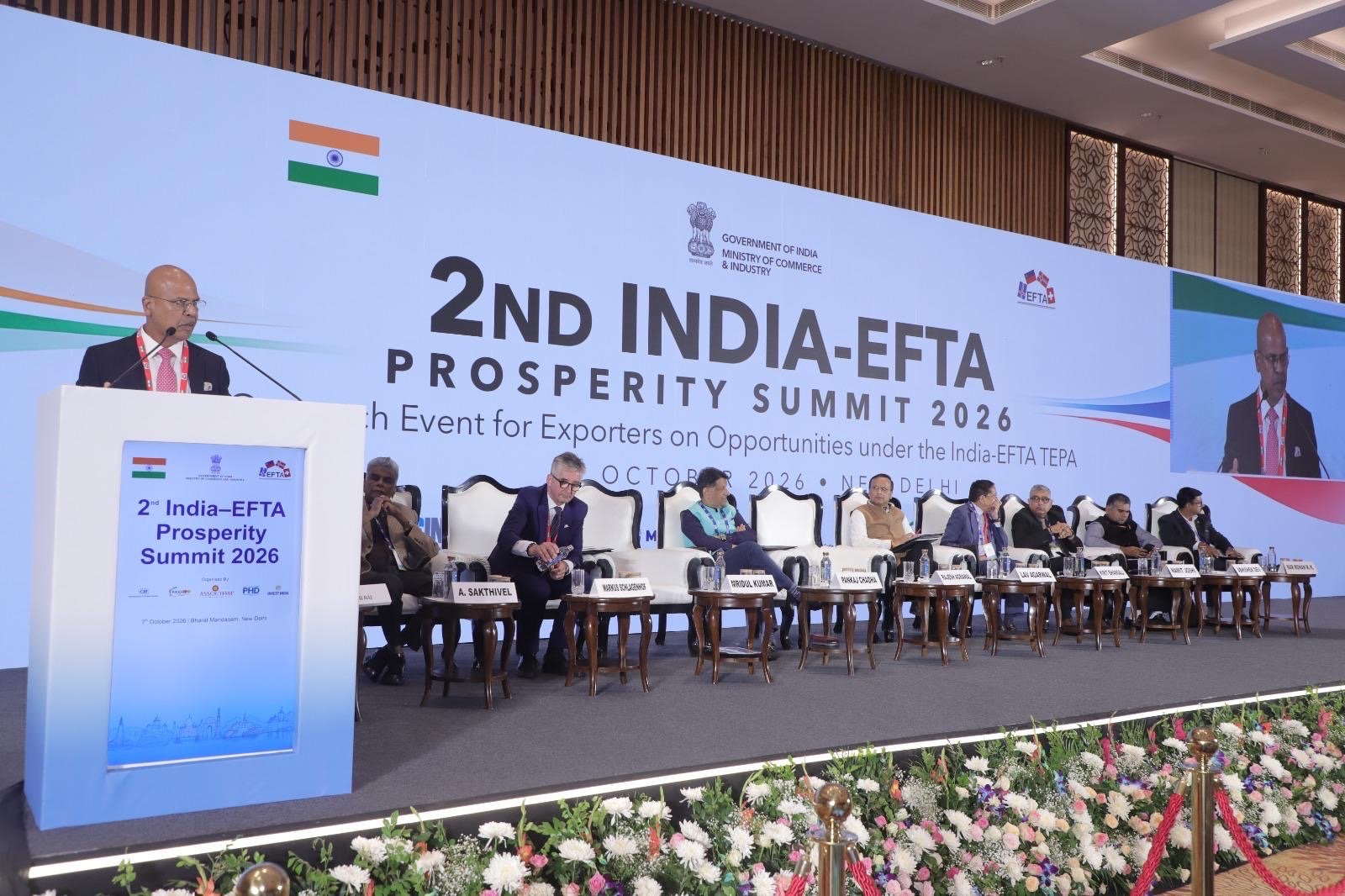
Speech by Amb Mridul Kumar at 2nd India–EFTA Prosperity Summit 2026
Commerce Secretary Rajesh Agrawal ji,
Members of the business delegations from EFTA,
Representatives of Indian industry and Export Promotion Councils,
ladies and gentlemen,
It is a pleasure to be with you here for the Second India–EFTA Prosperity Summit. This is the first anniversary of the Trade and Economic Partnership Agreement, TEPA in action.
Let me congratulate the organisers for bringing together policymakers, industry leaders, and entrepreneurs from India and the EFTA countries.
Over the past year, we have heard much about TEPA: market access, the investment commitment of 100 billion US dollars over 15 years, and the objective of facilitating one million direct jobs in India.
Based on these important elements, I would like to focus on practical ways to maximize TEPA provisions:
How can Indian businesses convert TEPA into actual export orders, lasting commercial relationships, technology partnerships and a stronger presence in global value chains?
A trade agreement does not automatically win a customer. A tariff concession does not guarantee a contract. These opportunities become real when businesses understand each other's needs, identify complementary capabilities and develop commercially viable partnerships.
Understanding the Swiss business ecosystem
For over three years, I have had the privilege of representing India in Switzerland and Liechtenstein. I have met leaders of major corporations, visited family-owned SMEs, interacted with chambers and industry associations, and engaged with universities, research institutions, start-ups and entrepreneurs.
One lesson has stayed with me.
The strength of the Swiss and Liechtenstein economies lies not only in their globally recognised corporations, but also in their highly specialised SMEs.
Many employ relatively small workforces, yet possess world-class expertise in precision engineering, industrial automation, specialised machinery, sensors, medical technology, advanced materials and other niche technologies.
For Indian businesses, this creates an opportunity to think differently.
An Indian engineering company can become a trusted supplier to a Swiss manufacturer. An Indian pharmaceutical company can become a contract-manufacturing partner. An Indian component maker can join a specialised industrial supply chain. An Indian technology company can collaborate with a Swiss SME to develop products for international markets.
We must move from seeing each other merely as buyers and sellers to recognising each other as partners in value creation.
Doing business in Switzerland
Let me offer some practical advice to Indian exporters.
Switzerland is an attractive market, but a demanding one. It places a high premium on quality, precision, reliability, transparency and long-term commitment.
First, do your homework before approaching a Swiss buyer. Understand the company, its products, customers and place in the supply chain.
Second, be precise in your commitments. If you promise a proposal on Monday, send it on Monday. If you commit to delivery in six weeks, plan accordingly. If a problem arises, communicate it early.
Third, make quality and compliance part of your business model from the beginning. Requirements differ across pharmaceuticals, food, textiles, medical devices and other sectors. Compliance with one country's requirements does not automatically establish compliance with another's.
And fourth, think long term. Swiss companies may take time in selecting suppliers, but consistent performance can lead to relationships lasting many years.
Do not promise everything. Promise what you can deliver—and then deliver it consistently.
TEPA: from agreement on paper to orders on the ground
How do we make TEPA work for Indian exporters?
I would encourage every exporter to begin with three questions:
First, what tariff treatment does TEPA provide for my specific product?
Second, can my product satisfy the rules of origin and documentation requirements?
Third, what technical, regulatory and commercial requirements must I meet to become a credible supplier?
The answers will differ from product to product. Exporters must examine the relevant tariff schedule, customs classification, origin requirements and market regulations rather than assume that every product receives the same benefits.
Our Export Promotion Councils can make this process more practical through product-specific TEPA guidance, targeted buyer–seller meetings and support on compliance and documentation.
We should measure progress not only by the number of delegations and seminars, but by the number of exporters using TEPA, securing qualified buyers and developing repeat business.
Where are the opportunities?
Let me highlight several sectors identified in our Mission's assessment.
Pharmaceuticals and speciality chemicals: Switzerland's pharmaceutical imports were estimated at approximately 67 billion US dollars in 2024, while imports from India were about 59 million dollars. Given India's pharmaceutical manufacturing base, this difference deserves closer attention.
Opportunities may exist in medicaments, pharmaceutical intermediates, speciality chemicals, diagnostic reagents and laboratory preparations. Indian companies should also explore contract manufacturing and dependable supply partnerships with Swiss pharmaceutical and chemical companies.
Gems and jewellery: Switzerland's watchmaking and luxury-goods ecosystem offers another avenue. India already has an established presence in unmounted diamonds. The opportunity is to build on this through reliable supply, consistent quality, traceability, appropriate branding and compliance.
Textiles and technical textiles: Switzerland imported approximately 9.2 billion US dollars of textile products across the categories examined in our assessment in 2024, while India's supplies were about 335 million dollars.
Indian exporters should look beyond conventional apparel to premium natural fibres, sportswear, professional garments, bedlinen and technical textiles. But access to a premium market requires chemical compliance, traceability, responsible sourcing, dependable delivery and consistent quality.
Leather goods also offer scope in luggage, travel goods, apparel and accessories for manufacturers able to combine craftsmanship, design, reliable production and credible environmental and sourcing practices.
Medical devices and precision instruments represent another potential area of complementarity. The Mission's assessment places Swiss imports in the broader category at approximately 9.8 billion US dollars in 2024, with India's supplies at about 40 million dollars.
The opportunity includes finished products, components and contract manufacturing, as well as engineering collaboration, product development and manufacturing partnerships.
Finally, agriculture, coffee, spices and processed foods offer opportunities for exporters who can demonstrate quality, distinctive origin, traceability and reliable supply. But exporters must understand Swiss agricultural tariffs, tariff-rate quotas where applicable, food-safety rules, labelling and other product-specific conditions.
These figures are not a promise that every product will succeed. They are an invitation to examine the market intelligently, identify specific buyers and develop propositions that can compete.
The question should not be only, “How much can we sell in Switzerland?” It should also be, “Which product, capability or specialised problem can we offer a Swiss customer better, more reliably or more competitively?”
Swiss technology in India
Let me now turn to the other side of the relationship.
India is a large and growing market for advanced machinery, specialised equipment and precision instruments. The Mission's assessment records Swiss capital-goods imports of approximately 1.04 billion US dollars in 2024.
But we should think beyond importing finished equipment.
A Swiss SME can work with an Indian contract manufacturer or component supplier, collaborate on product adaptation and prototyping, or establish a joint venture and progressively localise production.
For some companies, a phased approach may be more realistic: beginning with selected components, then moving to more complex assemblies, local engineering support, joint product development and additional manufacturing.
Such partnerships can help Swiss SMEs extend their reach while enabling Indian businesses to develop higher-value capabilities.
Of course, these arrangements require clear agreements on intellectual property, licensing, confidentiality, technical assistance, quality assurance and investment responsibilities.
The real opportunity is not simply to import Swiss technology into India. It is to combine that technology with Indian talent and manufacturing capacity to develop products and solutions for India and the world.
Turning introductions into partnerships
Our Export Promotion Councils and industry associations have an important role in making these opportunities actionable. I encourage them to work systematically with Swiss counterparts and institutions, including Switzerland Global Enterprise, the Swiss-Indian Chamber of Commerce and relevant industry associations.
The objective should be focused engagement: identify product categories, map prospective buyers and technology partners, organise targeted business meetings, and maintain follow-up after the initial introduction.
I also encourage Indian exporters to make full use of the Embassy of India in Switzerland.
The more specific your request, the more effectively we can explore relevant connections.
Ladies and gentlemen, let me conclude with three priorities.
For Indian exporters: understand your market, master your compliance requirements and approach Swiss buyers with a clear value proposition.
For our Export Promotion Councils: move from general outreach to product-specific market intelligence, targeted matchmaking and measurable commercial outcomes.
And for Indian and Swiss enterprises: look beyond the next shipment or purchase order. Explore partnerships in manufacturing, engineering, research and technology that create value for both sides.
India brings scale, talent, a large industrial base and entrepreneurial energy. Switzerland and Liechtenstein bring specialised expertise, technological depth, precision and globally connected businesses.
Our strengths are different, and that is precisely where the opportunity lies.
Thank you.















Copyright © 2026 Embassy of India, Berne, Switzerland. All Rights Reserved.
Website content managed by Jadon Webtech Pvt Ltd